Regenerative Medicine for Knee Pain: What It Can and Cannot Do
Regenerative medicine for knee pain, described plainly: the biology behind a joint that will not settle, why intra-articular delivery exists, and the limits.
Regen MDs Clinical Team//8 min read
The short version
Persistent knee pain is rarely one thing. Structural wear, inflammatory signalling that never resolves, and a matrix laid down in disarray usually arrive together, and they do not all answer to the same intervention.
Intra-articular delivery exists because a synovial joint is a closed compartment. It is a route, not a result. Getting something into a knee says nothing about what the knee then does with it.
Regenerative care does not regrow a joint. It is not a replacement for an indicated knee replacement, and it is not a reason to postpone a surgical opinion you have been advised to seek.
Everything offered here is adjunctive. It sits alongside your orthopedic care, your physical therapy and your prescribed medication, and your own physicians stay in charge of those.
The knee is the joint patients describe most precisely and understand least. Most people can point to the spot, name the movement that sets it off, and tell you how many stairs they manage before it starts. Far fewer have ever been told what is going on inside the joint while all of that is happening.
That gap matters, because it changes what is worth trying. A knee that catches and locks on a torn meniscus is a mechanical problem with a mechanical answer. A knee that aches every evening inside a joint environment that has stopped behaving is a different problem, and no brace will change its chemistry.
This article is about the second kind, and about where regenerative medicine for knee pain honestly sits in relation to it. That position is narrower than most clinic websites imply, which is rather the point of writing it down.
What a knee that will not settle looks like from the inside
Imaging gives you a headline: joint space narrowing, a few osteophytes, a grade. It is accurate and it is incomplete, because a film shows structure, and structure is the end of the story rather than the beginning of it.
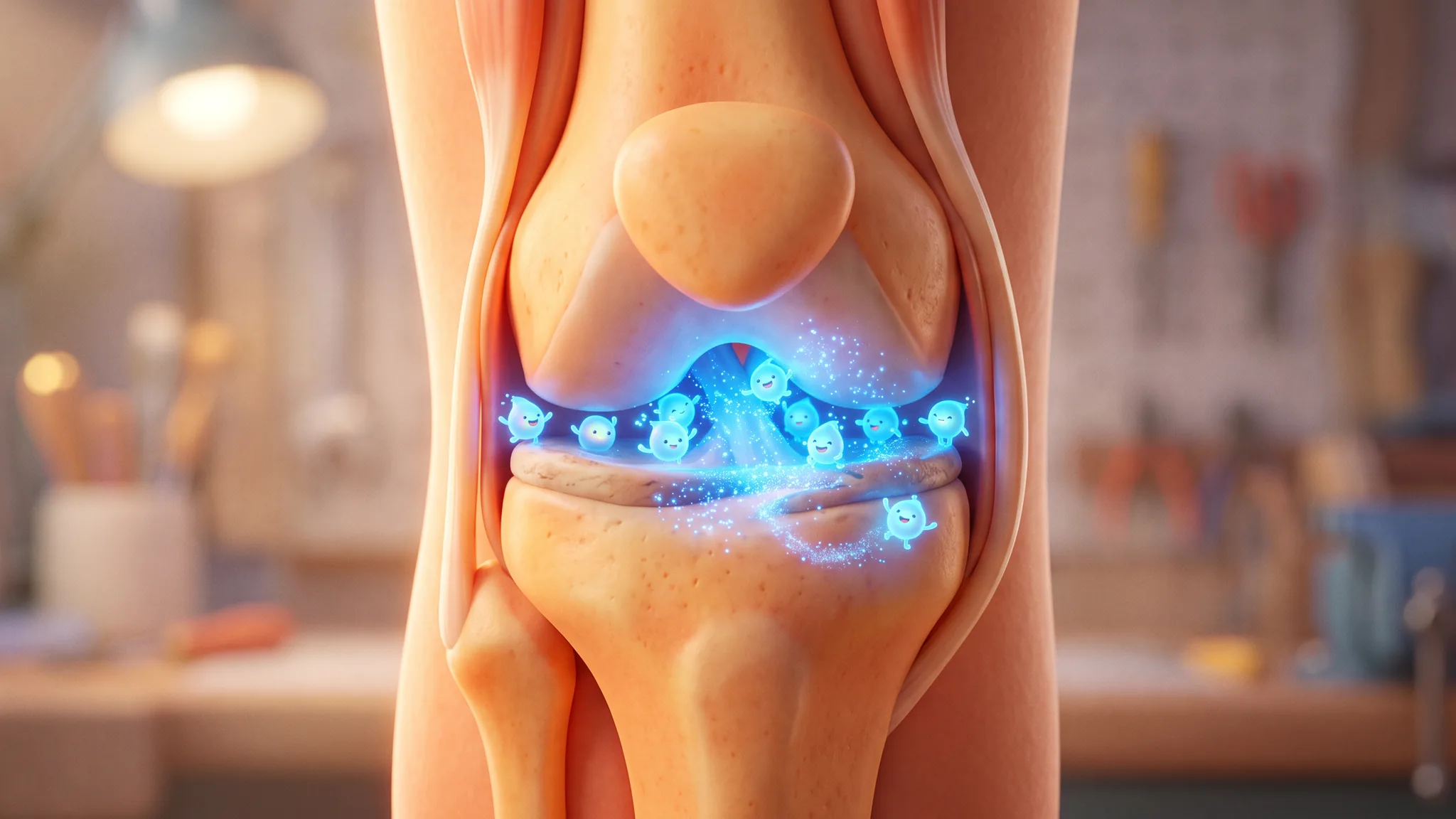
Underneath that headline there is usually an environment in trouble. Oxidative pressure runs high inside the tissue. Inflammatory signalling that ought to rise, do its work and quiet down instead idles at a low roar, which is what the phrase cytokine noise is trying to capture. The small vessels supplying the capsule work harder to deliver less, in the ordinary way that any overstretched supply line fatigues.
Then there is the extracellular matrix, the scaffold that holds cartilage and the tissues around it in a working arrangement. Under sustained inflammatory pressure it gets laid down disorganized, and disorganized matrix is not a passive result. It keeps the signalling switched on, which keeps the matrix disordered.
That loop is what people are describing when they say the knee is fine for ten days and then goes again for no reason they can identify. Nothing changed mechanically. The environment simply never stopped being inflamed.
Why intra-articular delivery exists as a route
A synovial joint is a closed compartment with its own fluid and a lining that regulates what crosses into it. That is excellent design for a hinge that has to carry your body weight several thousand times a day, and inconvenient for anything given systemically, which has to reach the joint through general circulation and arrive diluted.
Ultra RSF (Regenerative Signaling Factors) can be given intravenously, directly into a specific joint, subcutaneously, or into the nasal mucosa. A knee is the clearest case for the intra-articular option, because the target is one compartment and that compartment can be reached directly. Which route is appropriate is a clinical judgement rather than a preference, and the reasoning behind each one is set out in our guide to administration routes.
It is worth being precise about what Ultra RSF is, since the wider market is not. It is acellular: no living cells, no DNA, no RNA. It is a concentrate of more than 300 proteins and growth factors drawn from six regions of the placenta, screened under 21 CFR 1271.55 and characterized by next-generation sequencing and mass spectrometry. It is not a stem-cell therapy, whatever a competing clinic's homepage implies. The treatment page sets out how the material is made.
What a directed plan actually involves
Nobody should be receiving an injection at a first appointment. A plan that is worth anything starts with a conversation and an evaluation, and a meaningful proportion of those evaluations end with a physician saying that this is not the right approach for your knee.
01A complimentary 30-minute consultation with one of our medical providers, to establish what you are dealing with and whether regenerative care has any business being part of it.
02A physician evaluation that reads the likely drivers of your pain, assesses severity, reviews your current medications and any imaging you already have, and issues a plan or declines to.
03Treatment, which names the preparation, the route, the dose and the frequency. For a knee this may be intra-articular, systemic, or a combination, and it is frequently paired with molecular hydrogen.
04Ongoing tracking, with adjustments made against what is actually happening rather than against a schedule printed in advance, and notes shared back to your own physicians.
The hydrogen half of that plan usually runs at home. A typical starter course is 20 to 40 minute inhalation sessions, two or three times a week, for four to six weeks, before settling into a maintenance rhythm. What H₂ is understood to do, and the equally important question of what it is not, is covered on the molecular hydrogen page.
What regenerative care cannot do for a knee
This is the section most clinic pages leave out, so it gets stated flatly here. There are several things a regenerative protocol is not able to do, and no amount of enthusiasm changes any of them.
It does not regrow a joint. Cartilage that has gone is gone. A protocol may be aimed at the environment around what remains; that is a different and much more modest proposition.
It does not substitute for indicated surgery. If an orthopedic surgeon has told you that you need an arthroplasty or a repair, that recommendation stands and should be acted on.
It does not correct mechanical derangement. A knee that locks, gives way or catches has something structural going on, and structural problems want structural answers.
It does not come with a timeline you can hold anyone to. Tissue remodeling takes the time it takes, and it does not take the same time in every person.
It does not replace anything you are already prescribed. Nothing here is a reason to stop a medication, cancel physical therapy, or skip a follow-up with the physician who knows your history.
If a clinic promises that an injection will save you from a knee replacement, ask what happens to that promise when it doesn't.
How to think about the decision
Three questions do most of the work. Has anyone actually established why this knee hurts, as opposed to grading how worn it looks? Is there an indicated surgical or medical intervention that I am considering delaying? And is the thing being proposed to me described in terms of mechanism, or only in terms of outcomes?
The last one is the most useful filter. Mechanism can be examined, argued with and checked against what is known. An outcome claim with no citation behind it cannot be examined at all, which is precisely why it is used. The same test is worth applying to us.
If the answers point toward an adjunctive plan, it is reasonable to expect it to be described as one from the beginning: what it is meant to influence, over roughly what period, and how it will be coordinated with the doctors already involved in your care. Our consultations are free and run online in all 50 states, and part of what they are for is telling people the answer is no.
Can regenerative medicine rebuild the cartilage in my knee?
No. Nothing offered in a regenerative clinic regrows a worn joint, and any claim to the contrary is not supported by evidence. A directed plan is aimed at the inflammatory and matrix environment around the joint, which is a far more limited proposition.
Should I delay a recommended knee replacement to try this first?
No. If a surgeon has told you an arthroplasty is indicated, that advice stands and should be discussed with the surgeon who gave it. Regenerative care is adjunctive and is never a reason to postpone an indicated procedure.
Why would a physician inject into the joint rather than give something intravenously?
A synovial joint is a closed compartment, so an intra-articular route reaches it directly rather than through general circulation. The choice between routes depends on whether the problem is confined to one joint or is part of a wider systemic picture.
Is Ultra RSF a stem-cell treatment for knees?
No. Ultra RSF is acellular and contains no DNA or RNA. It delivers the signalling proteins and growth factors that cells release rather than the cells themselves, which makes it a materially different thing from a stem-cell preparation.
Do I have to stop my current pain medication?
No, and you should not change any prescription on the basis of an article or a consultation with us. Stay on the treatment your own physician has prescribed and discuss any changes with them directly.
This article is general health information, not medical advice, and does not create a physician–patient relationship. It describes mechanisms reported in the literature rather than guaranteed outcomes; individual response varies. Regen MDs provides you an alternative to your current care, and is complementary to your guideline-based medical care. Ultra RSF (Regenerative Signaling Factors) is not a stem-cell therapy. It is an acellular, non-biologic protein preparation — no cells, no DNA and no RNA. Talk to a licensed clinician before starting, stopping, or changing any treatment.